
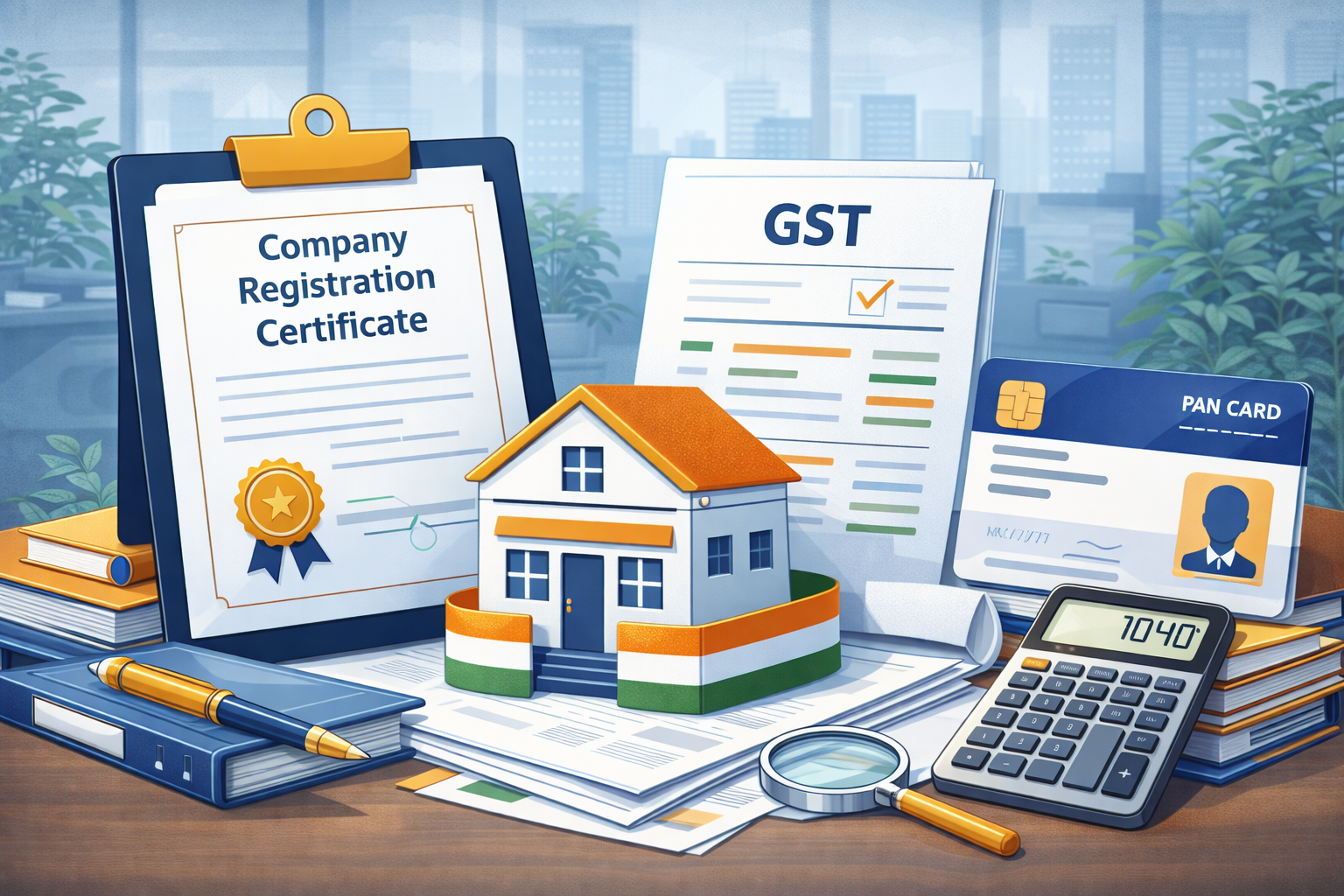
How to Set Up a Business in India: Complete Step-by-Step Guide
Setting up a business in India involves navigating a structured legal and regulatory framework. The process varies depending on your chosen business entity — sole proprietorship, partnership, LLP, or private limited company — and the nature of your operations. This guide walks you through every key step.
Step 1: Choose the Right Business Entity
Your first decision is the type of legal structure. Each has different implications for liability, taxation, and compliance:
Sole Proprietorship — simplest structure, full personal liability
Partnership Firm — governed by the Indian Partnership Act, 1932
Limited Liability Partnership (LLP) — combines flexibility with limited liability
Private Limited Company — most preferred for scalability, investor-readiness, and foreign investment
Choose the structure that aligns with your growth plans, funding needs, and risk appetite.
Step 2: Select and Reserve a Business Name
Choose a unique name that does not infringe on existing trademarks or violate the naming guidelines of the Registrar of Companies (RoC). For companies and LLPs, you can reserve the name online through the MCA portal using the RUN (Reserve Unique Name) service.
Step 3: Register with the Registrar of Companies (RoC)
For private limited companies and LLPs, registration under the Companies Act, 2013 is mandatory. Key documents required include:
Memorandum of Association (MoA)
Articles of Association (AoA)
Identity and address proof of directors
Registered office address proof
The entire process is completed online through the MCA21 portal.
Step 4: Obtain a Permanent Account Number (PAN)
Apply for a PAN card from the Income Tax Department in the name of the business entity. PAN is mandatory for opening a bank account, filing tax returns, and most regulatory transactions.
Step 5: Open a Business Bank Account
Open a dedicated business current account with a scheduled commercial bank. Documents typically required include PAN, Certificate of Incorporation, MoA/AoA, board resolution, and KYC documents of directors/partners.
Step 6: Register for GST
Businesses with aggregate turnover exceeding ₹20 lakh (₹10 lakh for special category states) are required to register under the Goods and Services Tax (GST) regime. Certain businesses — such as e-commerce operators and importers — must register regardless of turnover. Registration is completed online through the GST portal.
Step 7: Obtain Business Licences and Permits
Depending on your industry and location, you may need one or more of the following:
Trade Licence — from the local municipal authority, if applicable in State
FSSAI Licence — for food-related businesses
Environmental Clearance — for manufacturing or industrial operations
Drug Licence — for pharmaceutical businesses
IEC (Import Export Code) — for businesses engaged in international trade
Step 8: Comply with Labour Laws
If you plan to hire employees, ensure compliance with:
The Employees' Provident Fund (EPF) Act
The Employees' State Insurance (ESI) Act
The Payment of Gratuity Act
Minimum Wages Act
Shops and Establishments Act (state-specific)
Employment contracts and HR policies should be in place from day one.
Step 9: File Income Tax Returns
Maintain accurate books of account from inception. All business entities are required to file income tax returns annually. The applicable form and due date depend on your entity type and whether a tax audit is required under Section 44AB of the Income Tax Act.
Step 10: Obtain Industry-Specific Approvals
Certain regulated sectors require prior approval from sector regulators:
RBI — for NBFCs, payment aggregators, and certain fintech businesses
SEBI — for stockbrokers, investment advisers, and portfolio managers
FSSAI — for food processing and distribution
MEITY — for certain IT and data-related businesses
Step 11: Check State-Specific Requirements
Regulatory requirements can vary significantly by state. Profession Tax registration, state-level labour registrations, and local body approvals may be required depending on where your business is located.
Step 12: Protect Your Intellectual Property
If your business involves a brand, product, or technology, consider:
Trademark Registration — protects your brand name and logo
Patent Registration — protects inventions and processes
Copyright Registration — for creative and literary works
Early IP protection is far easier and cheaper than enforcement after infringement.
How PGA & Co. Can Help
At PGA & Co. Chartered Accountants, we have assisted hundreds of Indian and foreign businesses through the entire India setup process — from entity selection and incorporation to GST registration, bank account opening, and ongoing compliance.Our team combines Big-4 rigour with the responsiveness of a boutique practice, ensuring your business is set up correctly, compliantly, and efficiently.📞 +91 86998-87200 ✉ info@pgaca.in 🌐 Book a Free Consultation
Need expert guidance on this topic?
PGA & Co. Chartered Accountants can help. Speak with our team today.