
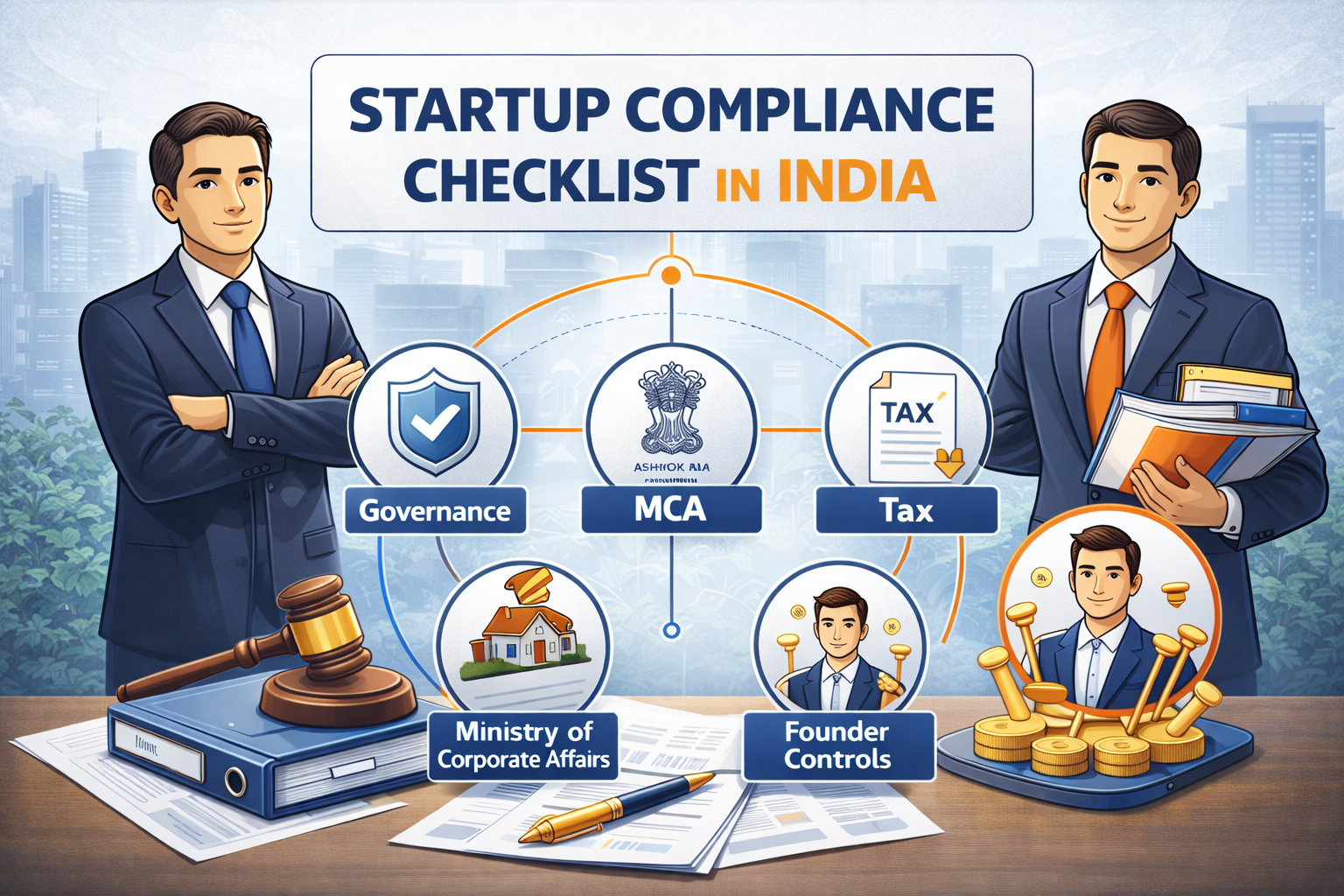
Startup Compliance Checklist in India: Governance, MCA, Tax and Founder Controls
Introduction: startup compliance is not a filing list — it is the governance system of the company
Startups often think of compliance as something that matters only once investors arrive, revenue grows, or the finance team becomes larger. That approach is risky. In reality, compliance begins from incorporation and affects almost every important business event thereafter: opening bank accounts, issuing ESOPs, raising funding, onboarding auditors, paying founders, entering into related-party transactions, maintaining cap tables, and eventually due diligence by investors or acquirers.
The practical problem is that early-stage companies are usually resource constrained. Founders prioritize product, hiring and fundraising. As a result, statutory compliance is often handled reactively, with board meetings documented late, registers updated irregularly and tax filings treated as isolated tasks rather than part of one governance framework. This may not hurt immediately, but it creates friction when the company wants to raise money, issue new shares, grant ESOPs or respond to investor diligence.
A good startup compliance checklist therefore is not just about avoiding penalties. It is about preserving legal hygiene. The cleaner the compliance record, the easier it becomes to scale, attract capital and defend decisions later. For serious founders, compliance is part of enterprise-building, not administrative overhead.
1. Incorporation-stage compliance: what must be set up correctly from day one
Once a startup is incorporated, the first layer of compliance is foundational. The company must have its constitutional documents, certificate of incorporation, PAN, TAN, bank account, statutory registers and internal records in order. Directors should have valid DIN and DSC where required, and the registered office documentation should be maintained properly.
The startup should also align its post-incorporation actions with the Companies Act framework: appointment of the first auditor, maintenance of books of account, issue of share certificates, and recording of the initial board resolutions. These tasks are often postponed because they do not feel operationally urgent, but many later corporate actions depend on them having been completed properly.
At a practical level, this is also the stage to fix finance ownership. Even if the company has no full-time CFO, one person should be clearly responsible for the compliance calendar, document storage and coordination with the CA, CS or legal counsel. Compliance gaps often arise not because nobody cares, but because responsibility is diffused.
2. Board and shareholder governance: where most startups become irregular too quickly
Board process is one of the earliest governance areas to slip in young companies. Meetings are held informally, approvals are exchanged on email or messaging apps, and minutes are reconstructed later. That may work for internal alignment, but it does not create good corporate records. A startup should maintain a consistent discipline around board meetings, resolutions, minutes and shareholder approvals where required.
This becomes especially important once the company starts issuing additional shares, granting ESOPs, approving related-party arrangements, borrowing funds, opening new bank mandates or authorizing fundraising documents. Investors and acquirers typically test the quality of board and shareholder records very closely.
The broader point is that governance should not begin only after the term sheet. If the company waits until a financing round to clean up all prior approvals, it often spends more time regularizing paperwork than focusing on the transaction itself.
3. Annual MCA compliance: financial statements, annual return and event-based filings
Every startup organized as a company must treat annual filings as non-negotiable. This includes the preparation and adoption of financial statements, the annual return process, and the relevant filings with the Registrar of Companies. In addition to annual filings, event-based filings become necessary when there are changes in directors, registered office, share capital, allotments, charges and other statutory events.
What makes startup compliance difficult is not the existence of these filings, but the way they interact. If a company has not kept its books properly, board approvals are missing, or the cap table has not been reconciled, the annual filing process becomes slow and vulnerable to error. If event-based filings are delayed, later fundraising rounds may expose those delays.
The best practical approach is to maintain a single company secretarial tracker covering annual filings, event-based filings, board calendar, statutory registers and due dates. Startups that do this early save significant cleanup cost later.
4. Tax compliance: income tax, TDS, GST and payroll are all part of one system
Founders often separate corporate law compliance from tax compliance, but from a risk perspective they are deeply connected. A startup needs to assess income-tax return filing, advance tax where relevant, TDS deduction and deposit, TDS returns, GST registration and returns where applicable, and payroll withholding for founders and employees.
The startup should be especially careful about founder remuneration, reimbursements, consultant payments, ESOP-related payroll questions and vendor classification. Many tax disputes begin with simple process gaps such as non-deduction of TDS, misclassification of a vendor payment, or inadequate support for reimbursements.
GST should not be treated as a pure operations issue either. Whether the startup provides SaaS, consulting, inter-state supplies, marketplace services or export-oriented services can significantly affect registration and compliance requirements. The right answer depends on the business model, not only on turnover.
5. Startup India and tax-incentive readiness: eligibility is one thing, documentation is another
For recognized startups, incentive frameworks such as DPIIT recognition, section 80-IAC profit-linked benefit for eligible startups, and the startup-specific relief around section 56(2)(viib) or ESOP-related timing can become valuable. Official Startup India materials continue to state the eligibility parameters for 80-IAC and startup-specific treatment around section 56, but founders often assume that recognition by itself solves the tax issue. It does not.
Recognition and exemption benefit are related but separate questions. The startup should preserve the documentation that supports innovation, scalability, share issuance, financial statements and qualification conditions wherever relevant. If tax benefit is ever examined, the startup will need more than a recognition certificate; it will need a coherent factual file.
For founders, the takeaway is simple: do not communicate tax-benefit assumptions to investors or employees unless the company has actually validated the relevant conditions and documented the position.
6. Cap table and securities compliance: equity mistakes become very expensive later
Many startup compliance issues eventually converge at the cap table. Share certificates, allotment records, share-premium support, section 62 approvals, PAS filings, ESOP grants, founder vesting arrangements and investor rights all need to reconcile to one clean ownership table. If they do not, the next funding round becomes more difficult.
This is especially important where the company has issued convertible instruments, SAFE-style instruments, founder shares with special rights, or multiple tranches of equity at different valuations. The startup should maintain one master securities folder with all approvals, allotment documents, valuation records, registers and filings.
If a startup ignores securities compliance in the first few years, later legal diligence can become painful. Investors do not merely look at the current cap table; they look at how it came into existence.
7. Related-party transactions and founder discipline
Early-stage startups often rely on founders and connected persons for office space, loans, advances, support services, reimbursements and bridge funding. That is commercially understandable, but related-party discipline is still necessary. Such arrangements should be documented, approved at the appropriate level and reflected clearly in the books.
The issue is not that related-party transactions are prohibited. The issue is that undocumented or informally priced transactions create governance risk. They can distort financial statements, complicate due diligence and create tax questions around disallowance, transfer of value or inadequate support.
The cleanest startups are usually not the ones that avoid all founder-connected transactions. They are the ones that document them properly and do not let convenience override governance.
8. Case illustration: the startup that lost three weeks in diligence over basic records
Consider a hypothetical SaaS startup that has grown quickly and is about to sign a seed round. Commercially, the business looks attractive. Revenue is rising, product-market fit is visible and the cap table appears simple. But once diligence begins, the investor discovers gaps: first auditor appointment was not documented properly, two board meetings were never minuted, one founder loan has no formal agreement, and an ESOP grant pool was discussed but not formally approved.
None of these issues is fatal in isolation. But together they create delay, legal cost and credibility friction. The round does not fail because the company is non-compliant in a dramatic way; it suffers because the company has to stop fundraising work and reconstruct records under time pressure.
The lesson is that compliance pain is often nonlinear. Small gaps accumulate quietly and then become expensive at the moment the company most needs speed.
9. Common mistakes founders make
The first mistake is assuming compliance can wait until after the next funding round. The second is treating tax, secretarial, payroll and cap-table work as separate silos. The third is relying on oral approvals or informal internal discussions instead of proper resolutions and minutes.
The fourth is underestimating the importance of document storage. A filing done once but not traceable later is almost as risky as a filing not done at all. The fifth is failing to assign internal ownership for the compliance calendar. The sixth is confusing startup incentives with automatic exemptions.
Most compliance problems are not caused by difficult law. They are caused by inconsistent discipline.
10. Practical checklist for startup founders
A strong startup compliance framework should generally include:
1. Incorporation documents, PAN/TAN, bank setup and statutory registers. 2. Auditor appointment and books-of-account readiness. 3. Board calendar, minutes, resolutions and shareholder approvals. 4. Annual ROC filings and event-based filings tracker. 5. TDS, GST, payroll and income-tax compliance calendar. 6. Cap-table folder with allotments, share certificates, valuations and securities filings. 7. ESOP approval, grant records and employee communication framework. 8. Related-party transaction approvals and documentation. 9. Startup India / DPIIT recognition and tax-benefit support file where relevant. 10. Centralized document repository and named internal compliance owner.
This checklist is the minimum governance backbone of a company that expects to raise capital and scale responsibly.
Conclusion: the best compliance system is the one that makes future growth easier
Startup compliance is easiest to ignore when the company is young and hardest to repair when the company is growing. The right mindset is not to view compliance as a burden imposed by law, but as the operating hygiene that allows the business to raise money, grant equity, answer diligence questions and scale without unnecessary friction.
For founders, a strong compliance system creates credibility. For investors, it reduces execution risk. For employees, it improves trust in compensation and governance. If your startup needs a founder-friendly but investor-grade compliance roadmap covering MCA, tax, payroll, ESOPs, cap table and DPIIT-linked readiness, PGA & Co. can help build a practical compliance framework that grows with the company.
Need expert guidance on this topic?
PGA & Co. Chartered Accountants can help. Speak with our team today.